
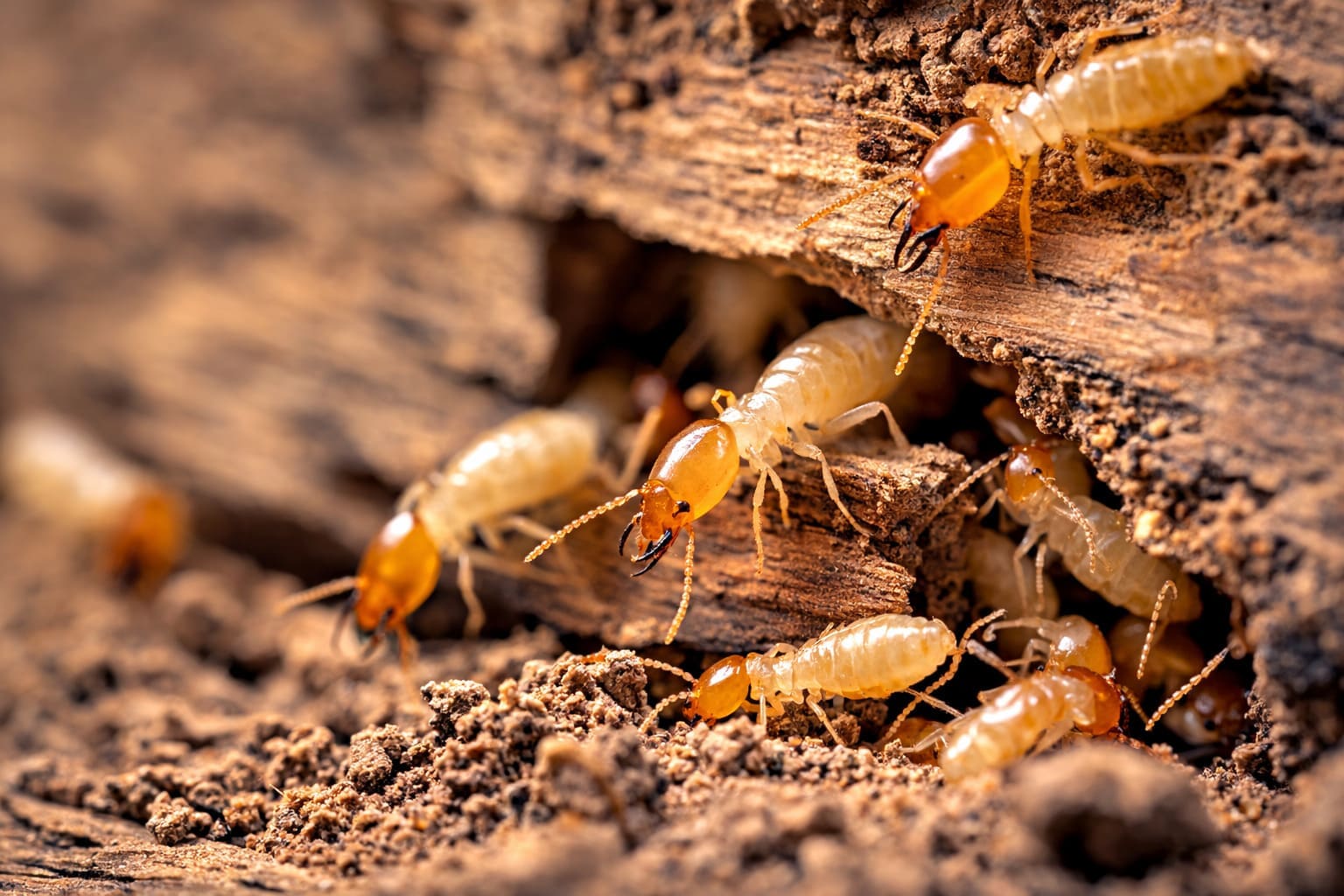
The most common signs of a termite infestation include mud tubes along your foundation, hollow-sounding wood, discarded wings near windowsills, small piles of frass (termite droppings), buckling paint, and tight-fitting doors or windows. Because termites work silently inside walls and floors, many homeowners don't notice the damage until it's already serious.
Termites cause an estimated $5 billion in property damage across the United States every year — and most of that destruction happens completely out of sight. Unlike a wasp nest or a mouse in the kitchen, termites leave few obvious clues. By the time most homeowners realize something is wrong, the colony has often been feeding for months.
Knowing what to look for changes everything. Here are the eight signs that pest control professionals check for first, and how to spot each one in your own home.
8 Signs of a Termite Infestation
Sign 01: Mud Tubes on Walls or the Foundation
Subterranean termites — the most destructive species in the U.S. — build pencil-width tunnels made of soil, wood particles, and saliva. These mud tubes protect the colony from open air as they travel from the ground into your home. Check the exterior foundation, basement walls, crawl spaces, and any wood that touches the soil. Finding even one tube is a strong indicator of an active or recent colony nearby.
Sign 02: Hollow or Papery-Sounding Wood
Termites consume wood from the inside out, leaving only a thin outer shell intact. Tap on baseboards, door frames, window sills, and wooden support beams with a screwdriver handle. A dull, hollow thud — instead of a solid knock — suggests the wood has been eaten through underneath. This is one of the earliest detectable signs of termite damage inside walls and floors.
Sign 03: Discarded Wings Near Doors and Windows
Once a termite colony matures, it sends out winged reproductive termites called swarmers to start new colonies. After finding a mate, they shed their wings — leaving small clusters near light sources, window ledges, and entry points. Finding a pile of small, equal-length wings is one of the clearest early warning signs that a termite colony is active nearby.
Sign 04: Frass — Termite Droppings
Drywood termites push their excrement out of the wood through tiny kick-out holes, leaving behind small pellets that resemble sawdust or coarse coffee grounds. These droppings — called frass — appear beneath wooden furniture, along baseboards, or below window frames. Unlike subterranean termites, drywood termites don’t use droppings to build tunnels, so you’ll see them accumulating in open piles on surfaces below the infested wood.
Sign 05: Buckling, Blistering, or Peeling Paint
When termites tunnel through wood just beneath a painted surface, they introduce moisture that causes paint to blister, bubble, or peel. This is easy to confuse with ordinary water damage — but if there’s no pipe, roof issue, or condensation source to explain it, termite activity inside the wall is worth investigating. Look especially along baseboards, floor trim, and around window casings.
Sign 06: Doors and Windows That Suddenly Stick
Termite damage warps wooden frames as the structural integrity of the wood degrades. If doors or windows that previously opened smoothly have become stiff or tight-fitting without an obvious reason, this warping is a red flag — particularly when it affects multiple points in the home simultaneously. Many homeowners chalk this up to seasonal humidity, missing the real cause entirely.
Sign 07: Visible Swarmers or Live Termites
Spotting live termites is an obvious but often misidentified sign. Termite swarmers are frequently confused with flying ants, but the differences are clear: termites have straight antennae, equal-length wings, and a uniform body width. Ants have bent antennae, wings of two different sizes, and a pinched waist. Swarms typically occur in spring and early summer, often triggered by warm weather following rain.
Sign 08: Sagging Floors, Ceilings, or Crumbling Wood
Advanced infestations cause structural wood to weaken noticeably. Floors feel soft or springy underfoot. Ceilings develop cracks or slight sags. In serious cases, walls produce a crinkling sound when pressed as the hollow galleries inside collapse. At this stage, structural timber has been compromised significantly — and the infestation has likely been active for a year or more.
⚠ Important
Termites are active 24 hours a day, 365 days a year. A mature colony can contain up to one million workers. In warm climates, multiple colonies can operate simultaneously on the same property. Never conclude you're pest-free based on a single sign being absent — look for a combination of two or more indicators.
Subterranean vs. Drywood Termites: Different Signs to Know
Not all termites behave the same way, and the evidence they leave behind differs by species. Knowing which type you may be dealing with helps you inspect the right areas of your home.
| Warning Sign | Subterranean Termites | Drywood Termites |
|---|---|---|
| Mud tubes | Yes — primary indicator | No |
| Frass / droppings | Rarely visible | Yes — key indicator |
| Hollow wood | Yes | Yes |
| Discarded wings | Near soil entry points | Near wood entry points |
| Moisture-related damage | Common | Less typical |
| Common entry point | Soil, foundation, wood-to-ground contact | Cracks in wood, attic vents, window frames |
Where to Inspect Your Home
Termites favor warm, moist, and dark environments. When doing a self-inspection, focus on these areas first:
Inside: Crawl spaces, basement joists and beams, under flooring near bathrooms or kitchens, behind drywall near plumbing, attic rafters, and any wood that has experienced past water damage.
Outside: The base of the foundation on all sides, wooden deck posts that contact soil, exterior window and door frames, utility entry points, and wood mulch or debris piled against the house. Maintain at least six inches of clearance between soil and any structural wood.
💡 Pro Tip
Run a flathead screwdriver firmly along baseboards, door frames, and exposed beams. Healthy wood resists the blade. Termite-damaged wood will crumble, give way easily, or sound hollow with minimal pressure. This simple test takes five minutes and can reveal damage that's completely invisible to the eye.
Frequently Asked Questions
Can I have termites if I don’t see any mud tubes?
Yes. Mud tubes are specific to subterranean termites. Drywood termites live entirely within wood and never build them. Even with subterranean termites, tubes are sometimes hidden inside walls, under slabs, or in crawl spaces not visible during a casual inspection.
How quickly can termites damage a home?
A mature subterranean termite colony of around 60,000 workers can consume roughly one linear foot of a 2×4 board in about five months. Larger or multiple overlapping colonies accelerate that timeline considerably — which is why early detection is so critical to limiting repair costs.
Are termite swarmers a sign the infestation is new?
Not necessarily. Colonies typically don’t produce swarmers until they are three to five years old. Seeing swarmers often means an established colony has already been present on or near your property for several years, even if no other signs were obvious until now.
What’s the difference between termite damage and water damage?
Water damage tends to be concentrated directly below a water source like a leaky pipe or roof. Termite damage is more widespread, follows the wood grain, and leaves behind a honeycomb pattern inside the wood with dried soil or frass packed into the tunnels — something water damage never produces.